
Aogami Blue #2 Steel: The Ultimate Guide to Japan’s Most Beloved Carbon Knife Steel

Why Knife Obsessives Swear By Blue Steel
There’s a moment every serious home cook eventually reaches. You’re mid-prep, breaking down a chicken or slicing paper-thin shallots, and you realize the knife in your hand is just there — a passive participant in the work. It doesn’t inspire anything.
Then you pick up a high-carbon Japanese knife, and everything changes.The steel sings through an onion. The edge holds. The knife feels like an extension of your hand, not a utensil in it.
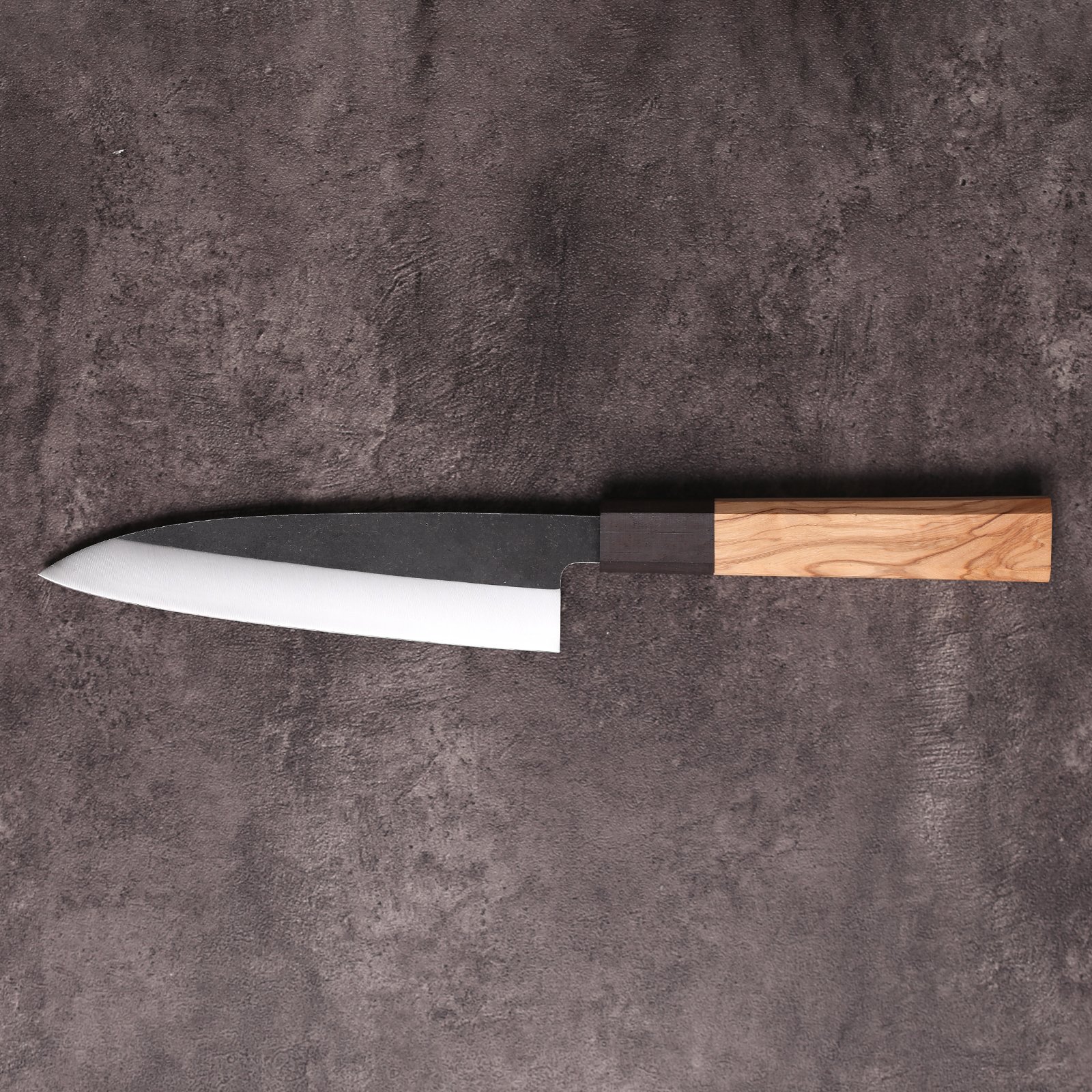
Aogami Blue #2 is the steel that converts casual cooks into knife obsessives. It’s the material behind some of the most revered Japanese blades in the world, and it’s what gives the Knife Forest Legacy Chef Knife its exceptional cutting character.
This guide explains everything — what Aogami Blue #2 actually is, how it compares to alternatives, how to care for it properly, and why a 6.5-inch Sanmai-forged knife with an olive wood handle is one of the smartest kitchen investments you can make for under $60.
What Is Aogami Blue #2? (The Metallurgy Made Simple)
“Aogami” (青紙) literally means “blue paper” in Japanese — named after the blue paper wrapping used by the legendary Hitachi Metals mill in Japan to distinguish their premium steel grades. Blue #2 sits in the middle of the Aogami family, flanked by White steel below it and Blue Super above it.
The key to understanding Blue #2 is its composition. It starts as a base of Shirogami (White) steel — already one of the purest cutting steels in the world — and adds small but critical amounts of chromium (0.2–0.5%) and tungsten (1.0–1.5%). These additions do something remarkable: they dramatically improve edge retention and toughness without sacrificing the extreme sharpness that makes Japanese steel so sought after.
Here’s how the composition breaks down in practical terms:
1. Carbon (1.0–1.2%): High carbon content is what allows the steel to reach extreme hardness. The Legacy knife is hardened to HRC 61 ± tolerance — the sweet spot between maximum sharpness and enough toughness for daily kitchen use.
2. Chromium (0.2–0.5%): Not enough to be “stainless” (you need roughly 10.5% for that), but enough to slow oxidation slightly, improve hardenability, and give the steel more predictable heat-treat response.
3. Tungsten (1.0–1.5%): This is the game-changer. Tungsten forms extremely hard carbides within the steel matrix, dramatically increasing wear resistance. This is why a Blue #2 blade will hold a razor edge far longer than most stainless knives costing twice as much.
4. Manganese (0.20–0.30%): Contributes to harden-ability and toughness during the quench process.
The result is a steel that occupies a very specific and desirable niche: easier to sharpen than stainless, harder-wearing than White steel, and more forgiving to use than Blue Super or Blue #1.
Blue #2 vs. the Alternatives: An Honest Comparison
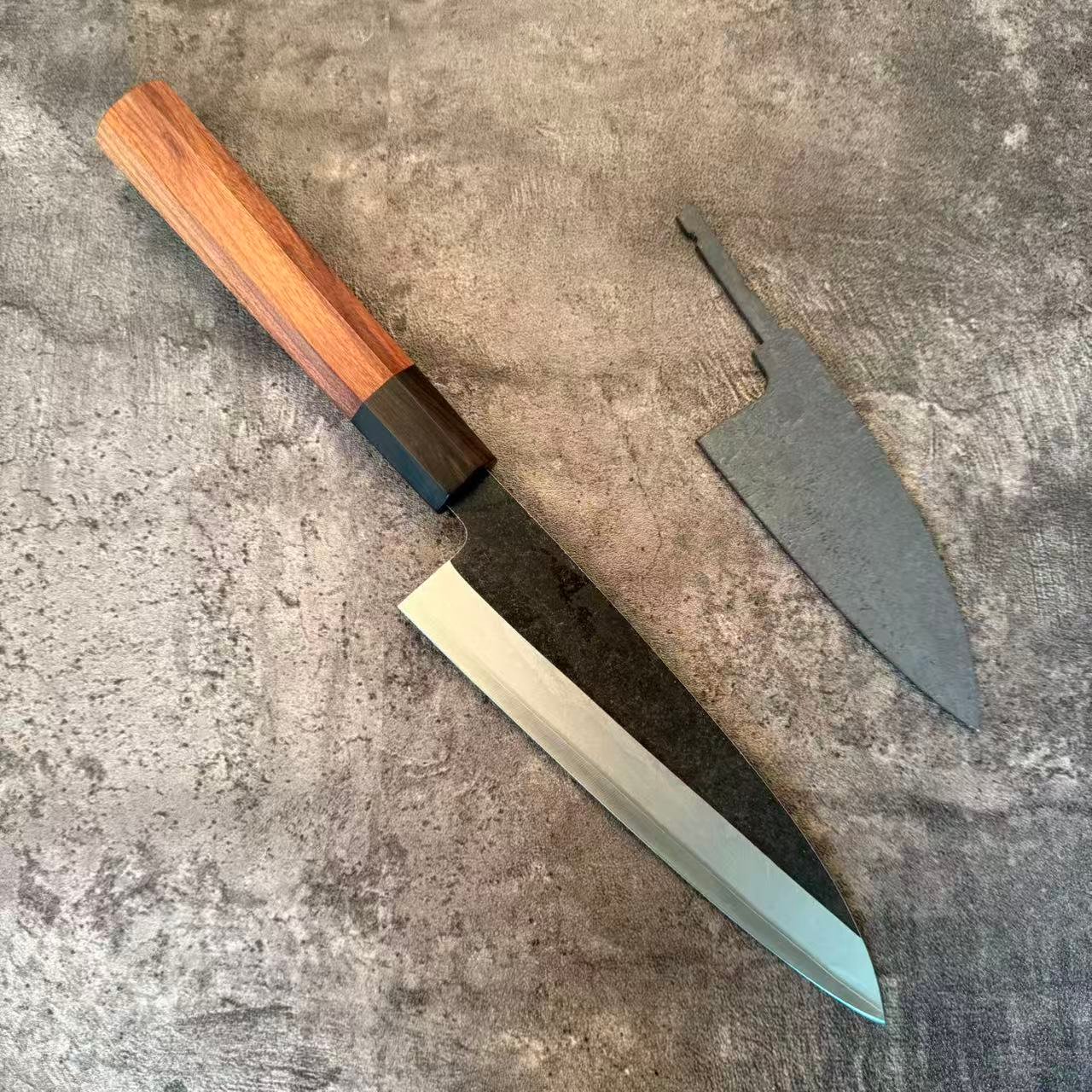
Before you invest in any knife, it helps to understand where its steel sits in the wider landscape. Here’s how Aogami Blue #2 compares to the steels you’ll commonly encounter:
Blue #2 vs. White #2 (Shirogami)
White #2 is purer and gets sharper at its peak. It’s the choice of highly experienced sharpeners who want maximum acuity for tasks like processing fish. But it’s also more brittle and loses its edge faster. Blue #2 adds enough tungsten and chromium to make the steel significantly more durable in a home kitchen, without meaningfully sacrificing sharpness. For most cooks, Blue #2 is the better choice.
Blue #2 vs. Blue Super (Aogami Super)
Blue Super adds vanadium and more tungsten to push edge retention even further. It achieves higher hardness (up to HRC 65+) and is preferred by many professional craftsmen. The trade-off: it’s harder to sharpen on coarser stones, and demands more skill on the whetstone. Blue #2 strikes the more user-friendly balance — a sharpening enthusiast can take it to a mirror edge on a 3,000 grit stone without specialized technique.
Blue #2 vs. VG-10 Stainless
VG-10 is the gold standard of “mid-range stainless” — found in popular Japanese brands you’ll recognize. It’s corrosion-resistant, holds a decent edge, and needs very little maintenance. But it doesn’t sharpen as easily or achieve the same peak sharpness as Blue #2. If you want low-maintenance, VG-10 makes sense. If you want the best cutting performance and don’t mind a small care ritual, Blue #2 wins.
Many of our customers first encounter Aogami Blue #2 while shopping for a small precision knife. If you’re considering a petty knife in Blue #2 steel, our complete petty knife guide covers sizes, uses, and what to look for.
Blue #2 vs. German Stainless (X50CrMoV15)
There’s no competition here in terms of sharpness. German steel (Wüsthof, Henckels, etc.) is designed for durability and ease of maintenance at the cost of edge geometry and hardness. Blue #2 will run rings around German stainless in the cutting department. The trade-off is that Blue #2 requires more attentive care — hand-washing and drying are mandatory.
The San-mai Construction: Why It Matters for the Legacy Knife
The Knife Forest Legacy knife uses Sanmai forging (三枚) — a construction method worth understanding because it directly affects how the knife performs and feels.
Sanmai means “three layers.” The hardest, most performance-critical steel (Aogami Blue #2 at HRC 61) forms the core — the very edge. This core is then clad on both sides with softer, more flexible steel.
The benefits are significant:
Edge performance: The ultra-hard Blue #2 core takes a razor edge and holds it. Because it’s protected on both sides, the brittle core steel is less exposed to the lateral stresses that would chip a mono-steel blade.
Structural flexibility: The softer outer cladding absorbs impact and flex that would otherwise propagate cracks through the hard core. A Sanmai knife is noticeably more chip-resistant than a single-steel blade at the same hardness.
Ease of maintenance: The softer outer layers sharpen away easily, so you’re only truly working the edge bevel when you strop or sharpen. The knife is more forgiving on the stone.
Visual character: On many Sanmai blades, the boundary between the core and the cladding is visible — a subtle wavy line called the hagane boundary that’s a mark of quality. It shows you exactly where the working steel begins.
This is why premium handmade Japanese knives use Sanmai or Damascus construction. It’s not just aesthetic — it’s engineering.
The Double Bevel: Designed for Every Cook
The Legacy knife uses a double bevel (also called a V-grind or symmetric bevel), which means the edge is sharpened on both sides equally — typically at 15–20 degrees per side.
This is the right choice for a western home kitchen context for several reasons:
1. Single-bevel knives (traditional Japanese yanagiba, deba) require specialized sharpening technique and are designed for specific tasks — primarily fish butchery and sashimi prep. They cut beautifully for their intended purpose but demand more skill to maintain and can be fatiguing for all-purpose prep work.
2. The double bevel on the Legacy makes it accessible to any cook. You can sharpen it on a standard whetstone, pull-through sharpener (though a whetstone is strongly preferred), or take it to a local sharpener. You can use it left or right-handed. And it performs exceptionally across the full range of kitchen tasks.
The Olive Wood Handle: More Than Just Beautiful
Not all handles are created equal, and the olive wood on the Legacy knife is a genuinely excellent choice — not just a visual one.
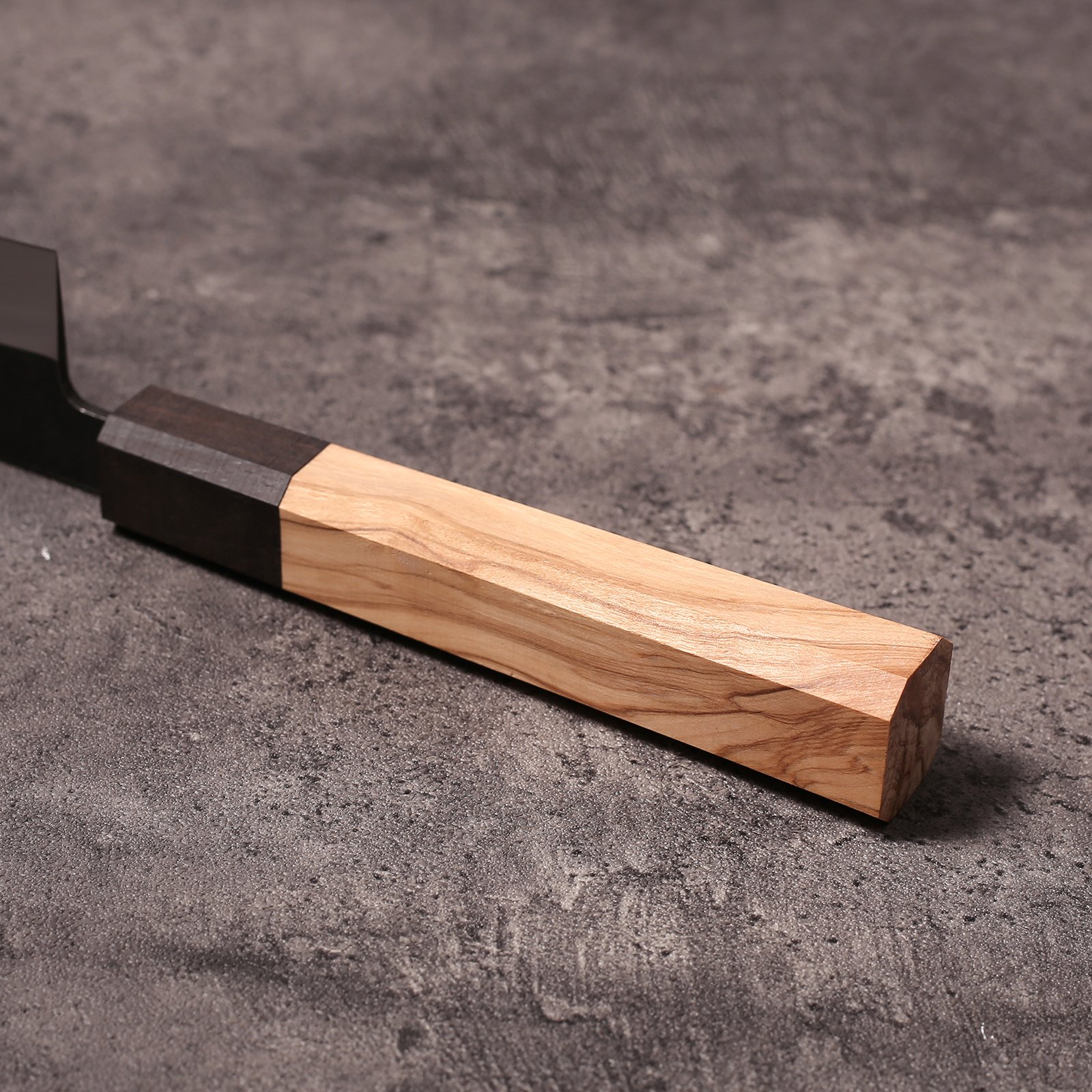
Density and hardness: Olive wood is one of the denser hardwoods used in knife handles, rating well on the Janka hardness scale. It resists dents, gouges, and warping under the stress of regular use.
Natural oils: The wood has inherent oils that help it resist moisture absorption better than lighter hardwoods. This matters enormously for a high-carbon steel knife, where handle-to-tang moisture can accelerate corrosion at the junction.
Grain character: Olive wood’s irregular, flowing grain means every handle is genuinely unique. No two Legacy knives look exactly the same. The hand-finishing process on each handle ensures the surface is smooth and ergonomically refined — not rough-cut.
The black bolster: The sleek black bolster between blade and handle provides the visual contrast that makes the knife look expensive. It also serves a practical function, sealing the transition zone between steel and wood to prevent food and moisture from entering.
Over time, the handle benefits from occasional treatment with food-safe mineral oil or beeswax, which deepens the color and keeps the wood from drying out.
The Patina: Embracing the Character of Carbon Steel
Here’s the thing that surprises most new owners of Blue #2 knives: the blade will change color over time.
High-carbon steel reacts with acids and oxygen through a process called oxidation. When exposed to onions, citrus, tomatoes, or even just air, the blade will gradually develop a grey-to-black discoloration called a patina.
This is not rust. Rust is red-orange iron oxide that actively damages the steel. Patina is a stable, passive layer of iron oxide that actually protects the blade from further corrosion. A well-developed patina is the sign of a well-used, well-cared-for knife.
The Legacy knife is explicitly designed around this idea — the product is named the “Legacy” precisely because it’s a knife meant to age. Each meal you prepare with it leaves a microscopic record in the steel. After months of use, the blade develops a dark, complex character that stainless steel can never replicate.
Some owners deliberately accelerate the patina by cutting lemons or potatoes immediately after receiving the knife. Others let it develop naturally. Either approach is correct — it’s entirely a matter of personal preference.
The key rule: If you see bright orange rust spots (not the grey-black patina), act immediately. Rub with a cork, a paste of baking soda, or a fine abrasive sponge, then apply a thin layer of camellia oil or food-safe mineral oil before storage.
How to Sharpen an Aogami Blue #2 Knife
One of the most-cited advantages of Blue #2 is that it sharpens quickly and easily — more so than stainless, and more approachably than harder steels like Blue Super or ZDP-189.
Here’s the process for home sharpening:
What you need: A combination whetstone — 1,000 grit for edge setting and repair, 3,000–6,000 grit for polishing and refining. A leather strop is a worthwhile addition for maintaining the edge between sessions.
The angle: For a double-bevel Japanese chef knife, aim for 15 degrees per side. A practical guide: rest the spine of the knife against the stone and lift it about the height of two stacked coins. That’s approximately 15 degrees.
The stroke: Work from heel to tip, maintaining a consistent angle, applying light-to-moderate pressure on the push stroke and lighter pressure on the pull. Alternate sides regularly so you don’t develop an uneven bevel.
When to sharpen: The steel paper test is reliable — if the blade catches or tears rather than gliding cleanly through a sheet of newspaper, it needs attention. Don’t wait until the knife feels dull. Frequent light touch-ups on a strop or fine stone take 60 seconds and extend the time between full sharpenings significantly.
What not to use: Avoid pull-through “V-type” sharpeners, which remove excessive material and can’t properly profile a fine Japanese bevel. Electric belt sharpeners also remove material aggressively. For a knife like this, the whetstone is the correct tool.
Daily Care: The Five-Minute Ritual That Protects Your Investment
Carbon steel demands a simple care routine. It takes less time than washing a cast iron pan, and it becomes second nature quickly.
After every use:
1. Hand-wash with warm water and a small amount of dish soap immediately after use.
2. Rinse thoroughly.
3. Dry completely with a clean towel — don’t leave it air-drying.
4. If you won’t use it for several days, apply a thin film of food-safe oil (camellia oil, mineral oil, or a neutral cooking oil) before storage.
Never:
1. Put it in the dishwasher. The heat, moisture, and alkaline detergent will damage both the steel and the handle.
2. Leave it soaking in water.
3. Cut frozen foods, bones, or hard-rind squash — these tasks will chip a hard edge.
4. Store it loose in a drawer where it can knock against other utensils.
Storage: A magnetic knife strip is ideal — the blade is supported, dry, and accessible. A wooden knife block also works well. Drawer storage with a blade guard is acceptable in a pinch.
Who Is This Knife For?
The Legacy is genuinely versatile in the people who will love it. But it’s not for everyone — which is actually a good thing.
It’s perfect for:
The home cook who has outgrown big-box store stainless knives and wants to experience what a truly sharp edge feels like. The confident cook who wants professional-level steel without a professional price tag ($59.90 is remarkable for a Sanmai Blue #2 knife with hand-finished olive wood). Anyone who wants a knife they’ll still be using in 20 years — and whose children might use after them.
Fathers, grandfathers, and serious cooks who appreciate tools with character — the free laser engraving makes the Legacy genuinely one-of-a-kind.
The cook who has been told “Japanese knives are hard to maintain” and wants to prove that wrong — Blue #2 is the most forgiving entry point into high-carbon Japanese steel.
It’s not the right fit for:
Cooks who put all their knives in the dishwasher and don’t want to change that habit.
Those who regularly break down whole animals or work with hard frozen products (a cleaver or more robust blade is appropriate for that).
Anyone who expects zero maintenance from a blade — Blue #2 asks for just a few minutes of attention per week.
 The Engraving: Making It a Legacy
 The Engraving: Making It a Legacy
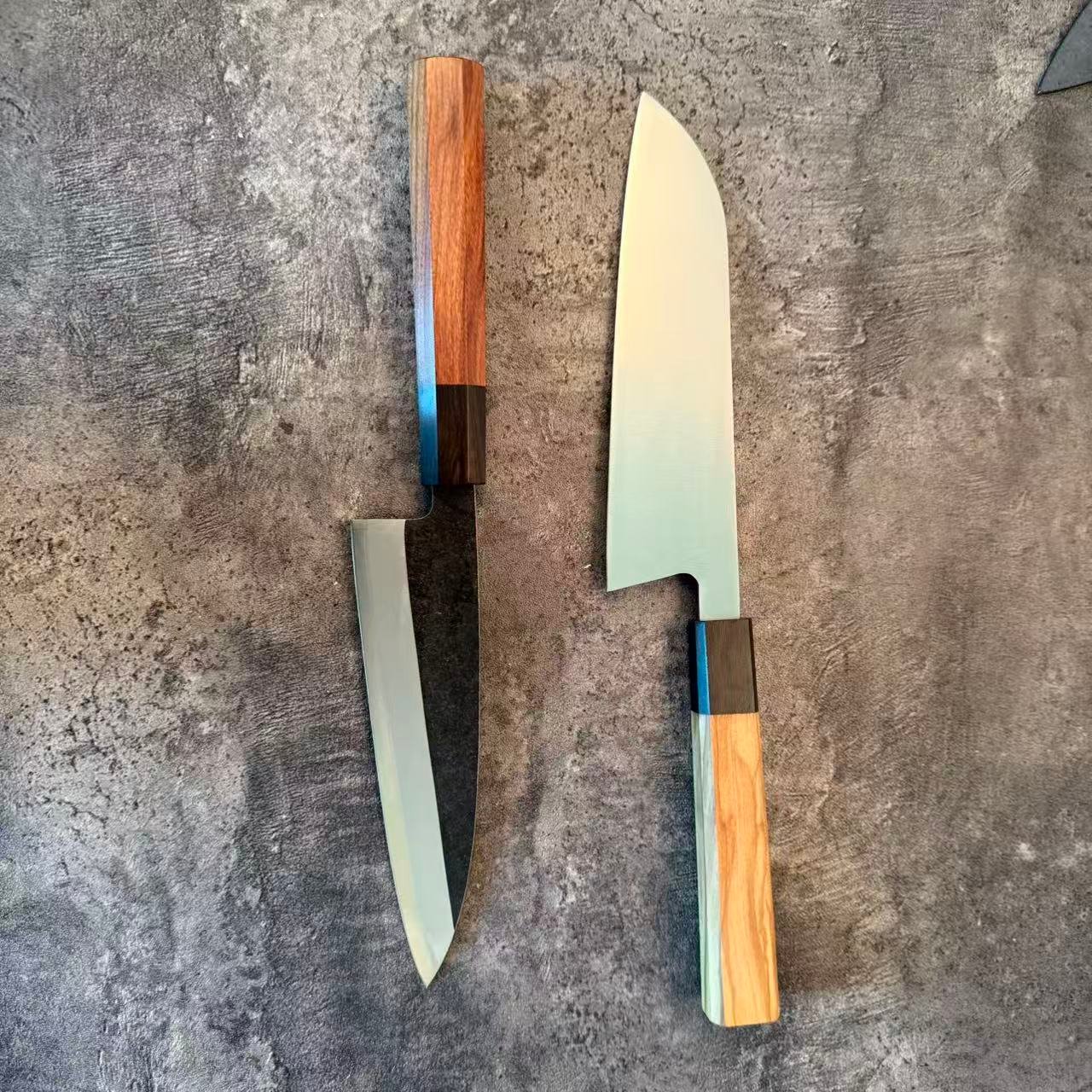
One detail that sets the Knife Forest Legacy apart from comparably-priced knives is the free custom laser engraving. This is worth lingering on.
A personalized knife isn’t just a gift — it’s a permanent object that carries a name, a date, or a message that outlasts the occasion. Fathers’ Day gifts are forgotten. Knives with your father’s name etched on the blade are not.
The laser engraving offered on the Legacy can accommodate names, dates, initials, or short messages. Because the knife develops a patina over years of use, the engraving actually becomes more prominent over time as the blade darkens around it — not less visible.
If you’re buying this as a gift, the engraving alone justifies the purchase. If you’re buying it for yourself, it’s a way to claim it: this is your knife.
Should You Buy a Blue #2 Knife?
If you’ve read this far, you probably already know the answer.
Aogami Blue #2 is the steel that serious home cooks move to when they want genuine performance without the steep learning curve of more demanding steels. It sharpens eagerly, holds its edge admirably, and develops the kind of personal character that mass-produced stainless blades never will.
The Knife Forest Legacy executes the material well: Sanmai construction, HRC 61, double bevel geometry, hand-finished olive wood, and free engraving — all at $59.90.
That’s a legitimate Japanese knife at a price that makes sense.
See the Legacy Chef Knife →
Have questions about Blue #2 care, sharpening, or which Knife Forest knife is right for your kitchen? Drop a comment below or reach out to us directly — we’re happy to help.