
Why Your Chef Knife Goes Dull So Quickly?

Knife care & education
Why Your Chef Knife Goes Dull So Quickly
After more than ten years working in the cutlery industry, I started KnifeForest with one goal: to make high-quality knives — and the knowledge to use them well — accessible to every kitchen at an affordable price. A great knife delivers a slicing and cutting experience that genuinely transforms the way you cook. But only if you use it correctly.
The biggest mistake: using a chef knife to chop bones
This is the single most common cause of rapid dulling I see, and it happens in home kitchens everywhere. Chopping through chicken bones, pork ribs, or fish spines places enormous lateral force on a blade designed purely for slicing and rocking cuts through soft to medium ingredients.
For bone work, you need a cleaver. A cleaver has a thick, heavy spine and a wide edge angle — typically 25–35 degrees — built to absorb the shock of hard materials. A chef knife's edge is ground to 15–20 degrees. That thinness gives you effortless precision through vegetables and proteins. Hit a bone with it, and that same geometry becomes a liability.
Cleaver
Thick spine, heavy weight, 25–35° edge. Designed to split bone and cartilage through force without chipping.
Chef knife
Thin 15–20° edge built for precision slicing and chopping vegetables and soft proteins — not bone or hard joints.
Damascus cladding knives: stunning but unforgiving
Modern Damascus clad knives — where a hard high-carbon steel core is wrapped in softer stainless steel layers — are some of the finest cutting tools available. The hard core, typically rated 60–67 HRC on the Rockwell scale, takes an exceptionally sharp edge and holds it beautifully during normal use.
But that hardness comes with a critical trade-off: brittleness. Unlike softer steels that flex under impact, a hard Damascus core will chip or micro-fracture instantly when struck against bone, frozen food, or any hard material. This is not gradual dulling — it is immediate, permanent damage to the blade's core.
⚠ Critical warning
Using a Damascus clad knife on bones or frozen food does not just dull the edge — it chips the hard steel core in a way that cannot be fixed by honing. Professional regrinding is the only option, and even then full recovery is not always possible.
When it gets dull: use a whetstone, not a honing steel
After a few months of regular use, any knife will need resharpening. For modern Damascus clad knives, many people make their second big mistake here: reaching for a honing steel.
Honing steels are designed to realign a soft or semi-hard edge that has folded slightly with use. They work well on standard European-style knives. But on a hard Damascus core, a honing rod does not realign — it chips. The hard steel cannot flex the way a honing rod expects, and the result is micro-chipping along the very edge you are trying to restore.
Whetstone
Removes a controlled layer of steel to form a clean new edge. Works with Damascus hardness. Use 1000 grit for resharpening, 3000–6000 grit to refine and polish the edge.
Honing steel
Designed for softer steels that bend under use. On a hard Damascus core (60+ HRC), causes micro-chipping rather than realignment. Avoid entirely.
Joseph's tip
A 1000/3000 combination whetstone is all most home cooks need. Use the 1000 side when the knife feels noticeably dull, and finish on the 3000 side to refine the edge. Done every few months, this keeps a Damascus knife performing like new for years.
The wrong cutting surface
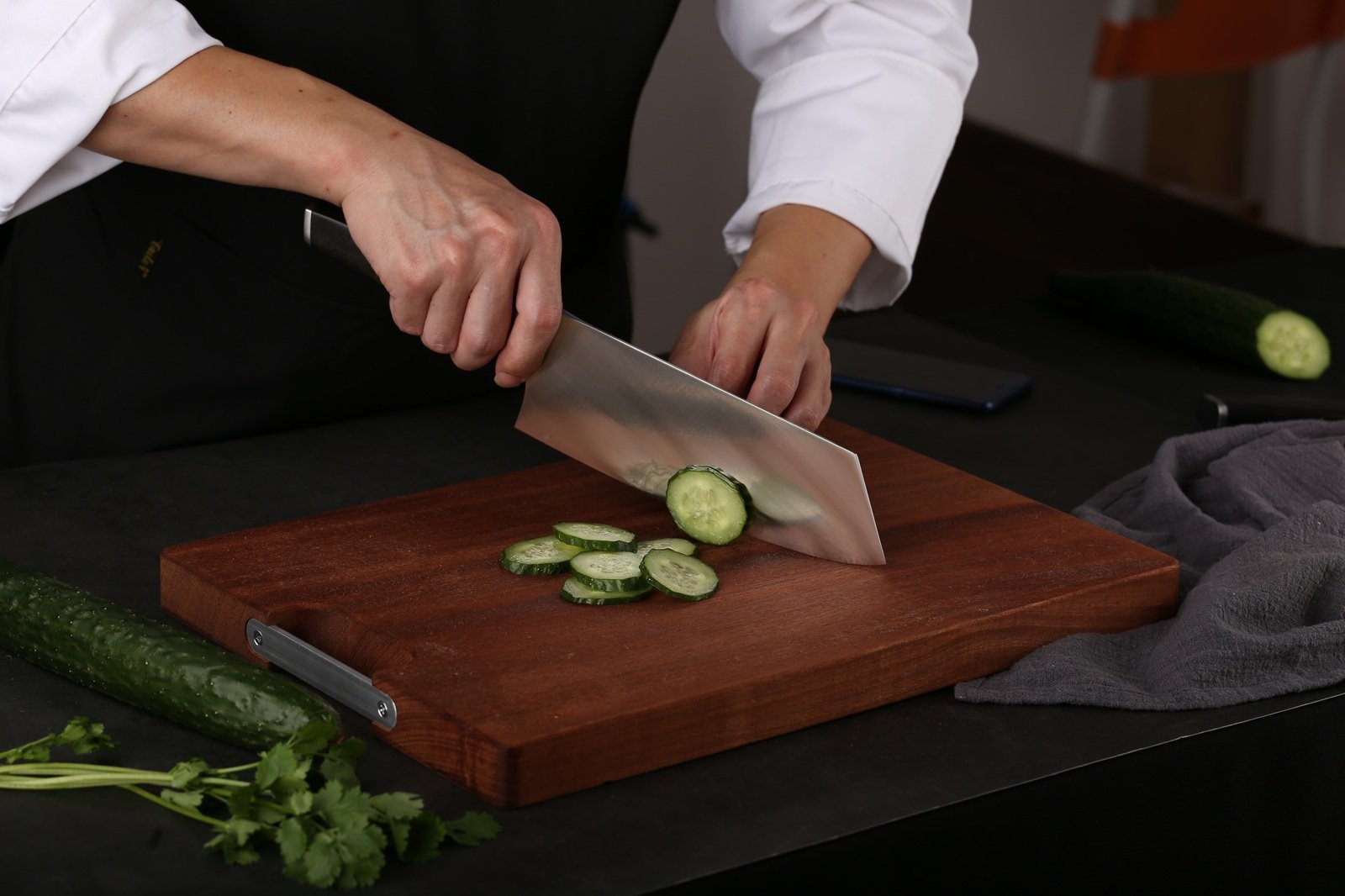
Glass, ceramic, marble, and metal boards are far harder than knife steel. Every stroke drags the edge against a surface that chips and folds the microscopic teeth that make it sharp. A wooden or soft plastic board has just enough give to let the edge pass cleanly without grinding.
Quick fix
Switch to an end-grain wood or HDPE board. Your edge will last two to three times longer with no other changes whatsoever.
The dishwasher
Dishwashers combine three edge-killers at once: rattling against other utensils during the cycle, high heat that weakens the steel's temper over time, and harsh alkaline detergents that corrode the fine edge. Even one cycle can undo a fresh sharpening. Always hand-wash with mild soap and dry immediately by hand.
Scraping with the blade facing down
After chopping, many cooks scrape food off the board using the blade edge facing down — a completely natural motion that happens to grind the sharpened edge against the surface like running it backward across a whetstone. The fix is simple: flip the knife over and use the spine to scrape. Fifteen seconds of habit change, years of edge life gained.
Every kitchen deserves a sharp knife and the knowledge to keep it that way. Use the right tool for the job, treat your Damascus blade with care, and a quality knife will reward you with years of exceptional cutting performance.
— Joseph, KnifeForest