
How Much Should You Really Spend on a Chef Knife?

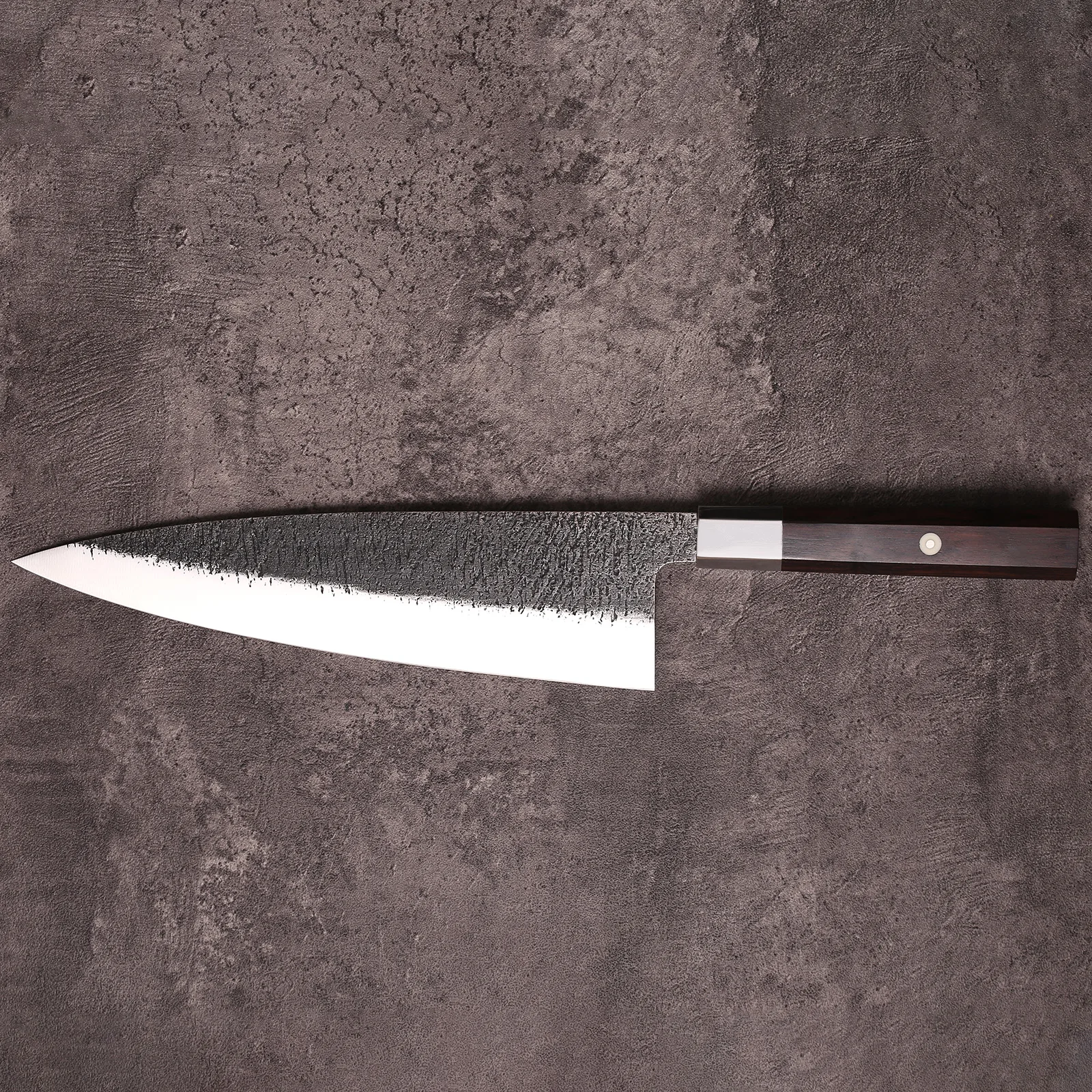
Walk into any kitchen store and you’ll find a chef knife for $29 and a chef knife for $329 sitting three feet apart. Both of them cut onions.
Here’s the part most knife sellers won’t say out loud: for the vast majority of home cooks, the right number sits somewhere between $60 and $130. Spend more and you’re buying craft, materials, and story. Those are real things. They’re just not the reason your onions are getting crushed instead of sliced.
I’ve spent years inside knife factories watching these blades get made. So let me tell you what actually changes when the price goes up, and what doesn’t.
Why good knives got cheap
Twenty years ago, a genuinely sharp, hard, well-balanced kitchen knife was expensive because making one was hard. That changed — and not because anyone lowered their standards.
Steel got better and cheaper. Alloys that used to be exotic are now standard mill stock. A modern stainless like 10Cr15MoV or VG-10 holds an edge that would have counted as premium performance in 2005.
Heat treatment got precise. Vacuum furnaces with data logging and sub-zero treatment killed the hardness lottery. A good factory can hold 58–60 HRC across a run of thousands of knives. That consistency used to be a master’s craft.
Grinding got automated. CNC and robotic grinding put a thin, even bevel on a blade in under a minute — and blade geometry is the single biggest factor in how a knife feels in your hand.
The floor moved up. A well-made $70 knife today outperforms a $200 knife from twenty years ago.
What you’re actually paying for above $150
Not nothing. Let’s be fair about it.
Hand work — hand-forging, hand-thinning, hand-fitted handles. Hours of skilled labor per knife, and you can feel it.
Wages. A knife finished in Japan or Germany carries that country’s labor cost.
Small batches. A maker producing 300 knives a year has to price like one.
Materials at the far edge. Powdered-metallurgy steels, stabilized burl handles, carbon core steels that demand more care from you in return.
All of that is legitimate. None of it makes a knife four times sharper. It’s the difference between a very good tool and a very good tool that’s also a beautiful object made by someone you can name. Worth paying for if that’s what you want. Not required to cook well.
What actually matters, in order
Geometry behind the edge. Thin wins. How quickly the steel thins out as it approaches the edge decides whether the knife parts food or shoves it apart.
Heat treatment. Look for a stated hardness. 58–61 HRC is the useful window for stainless.
Edge angle. Japanese-style knives are commonly ground around 15° per side, German-style closer to 20°. The thinner angle bites better; the thicker one survives abuse better.
Length and profile. 8 inches (210mm) suits most home kitchens. A flatter profile favors push cuts, a curvier belly favors rocking.
Handle and balance. Judge it over twenty minutes of prep, not twenty seconds in a store.
Three checks you can do with the knife in your hand
Specs on a page are easy to fake. These aren’t.
Feel for the shoulder. Lay your fingernail flat on the blade face and slide it down toward the edge. On a well-ground knife the steel thins gradually and your nail rides smoothly onto the bevel. On a cheap one you’ll hit a distinct step — an abrupt shoulder where the grind stops. That step is what wedges into a carrot.
Pinch the spine at the heel. Around 2 to 2.5mm feels nimble in an 8″ chef knife. 3mm and up is a wedge. Then pinch the spine again near the tip. It should be noticeably thinner. If it’s the same thickness front to back, there’s no distal taper and the knife will feel dead in your hand.
Find the balance point. Pinch the blade between thumb and forefinger just ahead of the handle. A well-balanced chef knife will sit roughly level there. If the handle drops hard, there’s a lump of cheap steel or filler in it doing nothing for you.
One more, if the shop allows it: slice a sheet of paper held loose in the air. A properly sharpened knife glides. A factory edge that only tears or catches was ground fast and finished never.
What matters less than the internet claims
Exotic steel. You cook four nights a week, not eight hours a day on a line. Decent stainless at 59 HRC will go weeks between touch-ups. Powdered steel buys longer edge life — and a much harder time sharpening.
Damascus layer count. The pattern lives in the cladding, not the cutting edge. It’s beautiful. It isn’t performance. [Internal link: Damascus knife types article]
Full tang. A properly built hidden-tang or wa handle is not a weak point in a kitchen knife.
Full bolsters. Reassuring in the store, a nuisance to sharpen around for the next ten years.
About those big block sets
This is where most home cooks’ money actually goes, so let’s be straight about what’s in the box.
Piece count is the headline because piece count is cheap. Steak knives and shears cost almost nothing to add, so a set grows from eight pieces to fifteen without the price moving much. The number on the box tells you very little about the knives inside it.
The knives repeat themselves. Nearly every set pairs an 8″ chef knife with a santoku that does the same job, adds a slicer most people use twice a year, then fills the count with steak knives. You’ll reach for two of them.
The steel gets described, never specified. “High-carbon stainless steel.” “German stainless steel.” Neither is a grade, and no hardness figure appears anywhere. In practice these blades land in the low-to-mid 50s HRC, which is soft. A soft edge doesn’t chip — it rolls. It folds over sideways under load and stops cutting while still looking perfectly intact. That’s why the knife feels fine for two weeks and then starts crushing tomatoes instead of slicing them.
The blades are stamped and thick behind the edge. No taper down the spine, no thinning above the bevel. A blade like that doesn’t part a carrot, it wedges through and splits it. You feel it as the vegetable cracking away ahead of the edge.
The colored coating is a finishing shortcut. A polished blade face takes several belt and buffing stages, and every stage costs labor. A sprayed coating hides a rough grind under an even finish and keeps low-grade stainless from spotting with rust in a shipping container. What it can’t do is improve the cut — the apex has to be bare steel, so you grind the coating off the moment you sharpen. And it doesn’t stay on the blade. It chips at the edge and the shoulders, exactly where the knife meets the board, and those chips go into the food. Most listings never say what the coating actually is. Ceramic on one page, non-stick on another, describing the same knife.
The sharpener built into the block is a tell. Nobody engineers a sharpener into the furniture for a blade that holds an edge. And a pull-through slot scrapes a coarse V into the steel, removing far more metal than sharpening should, so every pass moves the knife further from the geometry it needed to begin with.
“Dishwasher safe” is the same kind of tell — true, in the sense that there’s nothing on that knife good enough to be damaged.
None of this makes these sets useless. They cut, and they’ll cut for a season or two. Just buy one knowing that’s what it is: a disposable tool sold in the language of a permanent one.
Already own one? Don’t throw it out
Most people reading this have a block set on the counter right now. You don’t need to replace it. You need to stop asking it to do the one job it’s worst at.
Buy one good 8″ chef knife. That single knife handles roughly 90% of what happens on a cutting board, and it’s the piece where soft steel and a thick grind hurt you most.
Keep the bread knife. A serrated blade does its job on crust regardless of steel quality, and you were never going to sharpen it anyway.
Keep the paring knife. Light work, short blade, low stakes.
Keep the block, use it for storage — but stop putting your new knife through the built-in sharpener. That slot will undo a good bevel faster than anything else in your kitchen.
Then spend $30 on a whetstone. One knife, one stone, and a wooden board will transform your prep more than replacing all fifteen pieces would.
What to buy instead, if you’re starting fresh
One 8″ chef knife. One utility knife. One bread knife. That covers about 95% of home cooking.
Put your money in the chef knife and go modest on the other two. Skip the block; a magnetic strip or a couple of blade guards will do. You’ll spend roughly what a big set costs and cut better for the next ten years.
The price bands, honestly
Under $30. Soft steel, thick grind, dull in a month. Fine as a backup or a camp knife. Not your main blade.
$30–$60. Entry level done right. Look for a named steel grade and a stated hardness — at this price, one or two brands will give you both, and those are the ones worth having.
$60–$130. The sweet spot, and where most home cooks should stop. Real steel, real heat treatment, a grind thin enough to be genuinely pleasant. This is where a knife stops feeling like an appliance and starts feeling like a tool.
$130–$400. Craft territory. Hand finishing, forged construction, named makers. Buy it because you want it.
$400 and up. Collecting. Nothing wrong with that — just be clear with yourself about what you’re doing.
Make a $70 knife cut like a $300 one
This is where the real gains are, and it costs almost nothing.
Learn to sharpen. A $30 combination whetstone (1000/3000 grit) and twenty minutes on YouTube will do more for your cutting than a $200 upgrade. A sharp cheap knife beats a dull expensive one every single time.
Use a wood or rubber cutting board. Never glass, stone, ceramic, or bare countertop — those destroy an edge in a handful of cuts.
Hand wash and dry immediately. Yes, even the ones that say dishwasher safe.
Don’t store it loose in a drawer. A magnetic strip or a blade guard costs less than lunch.
Stop scraping with the edge. Flip the knife and use the spine to sweep your diced onion off the board.
Common questions
Is a $50 chef knife good enough? For most home cooking, yes — provided the listing names a steel grade and a hardness. A $50 knife with 5Cr15MoV at 56 HRC and a thin grind will outperform an $80 knife that specifies nothing. The number matters less than what’s behind it.
Do expensive knives stay sharp longer? Somewhat, and less than you’d think at home. Harder steel and better carbide structure do hold an edge longer, but edge retention is mostly a professional concern — eight hours a day on a line versus forty minutes a night. What you’ll notice at home is how the knife feels going through food, and that’s geometry, not steel.
How often should I sharpen a chef knife? For typical home use, a full sharpening on a stone every three to six months, with a few passes on a honing rod or fine stone every couple of weeks. If you’re pressing harder than you used to, it’s already overdue.
Is a santoku better than a chef knife? Neither is better; they’re shaped for different motions. The santoku’s flatter profile suits straight up-and-down push cuts, the chef knife’s curved belly suits rocking. Owning both is the redundancy that pads out block sets. Pick the one that matches how you already cut. [Internal link: petty knife article]
Are Japanese knives better than German ones? They’re different trade-offs. Japanese knives are typically harder and thinner — they cut better and chip more easily. German knives are softer and thicker — more forgiving, less precise. A hard thin blade rewards care; a soft thick one tolerates carelessness.
Is a knife block set ever worth buying? If you want steak knives, shears, and storage in one box and you’re clear-eyed about the chef knife inside it, sure. Just don’t expect the main blade to be the last one you buy.
You don’t need to spend $300 to cut well at home. You need a knife with honest steel, an honest heat treat, and a thin grind — then you need to keep it sharp and stop cutting on glass.
Buy the $80 knife. Spend $30 on a stone. You’ll out-cut the guy with the $400 knife, the dull edge, and the glass cutting board.
Where we come into this
Fair disclosure: we make knives. KnifeForest is a factory, not a reseller. The blades ship from the same floor where they’re forged, heat treated, and ground — no distributor, no importer, no marketplace margin stacked on top. That’s most of the reason our prices sit under what the same specification costs on Amazon.
But price isn’t really the argument for buying factory-direct. Traceability is.
Every question I told you to ask in this article, we can answer, because we’re the ones who did the work. Ask the steel grade and you get an answer — 10Cr15MoV, VG-10, Aogami Blue #2 — not “high-carbon stainless.” Ask the hardness and you get a number off the batch, not silence. Ask why a blade is finished the way it is and you get an answer about grinding and polishing stages, not a color.
No coating covering the grind. No sharpener built into the furniture. No fifteen pieces padding out a number on a box.
So hold us to exactly the test you’d hold anyone else to. Check the spine at the heel and again at the tip. Run your nail down the face and feel for the shoulder. Ask us for the hardness before you buy, not after.
That’s the whole reason this article exists. A knife should be able to survive being examined.